Thursday, June 16, 2011

June 11-13 Big Bull Redfish in Venice, LA


A few friends fished with Capt Keith Kennedy out of Venice, LA during June 11th to 13th for big bull redfish. For the dates, 55 big bulls averaging 22 lbs were landed with many more lost. The largest bull red was in the 30lbs range. The best lure of choice was the six inch bomber mud minnow in pearl and chartreuse tail. Water temperatures have really warmed up at 87 deg. The key for big bulls is the wind and they experienced calm waters with good clarity.


Capt Keith provides all tackle, housing, meals, and even down to the fishing license. A few good dates are still available to get into this great action for monster reds!


Contact Capt Keith of Born To Fish Charters at 504-908-3108

Tuesday, June 14, 2011

PEACOCK BASS


Peacock bass are not really a bass. They were named this to attract sportfishermen from around the world to battle these monsters. In reality, peacock bass are a member of the cichlid family.


Peacock bass are also known as pavon and tucunare. They are native to South America's Orinoco and Amazon River basins. They have recently been introduced into the Florida canals.


Peacock bass have blotches on side of its face and the speckled peacock has 3 distinct vertical bars on its body. The speckled peacocks are the largest of the peacocks attaining weights up to 30lbs. Most peacocks roam in gangs as they are somthing of a thug!


Peacocks have an "eye" on its tail to fool prey while attacking hence the name peacock similar to the bird!


Peacock Bass are known for top water explosions often tossing lures high into the air only to hit them again and again.


Peacock bass mouth brood their fry with the father attacking any enemy around the nest. The male peacock obtains a pronounced forehead of fatty tissue during sexual maturity.


They are very fast swimmers and can put a test to the best of fishermen with their rod breaking runs.


The IGFA recognizes 4 types of peacock bass, blackstrip peacocks or royal pavon which get up to 10lbs, the butterfly peacock which have 3 blotches on its body instead of bars. They are also found in Florida and reach weights up to 16lbs. The Orinoco peacock is easily confused with the butterfly peacock. The speckled peacock is the largest of the peacocks reaching weights to 30lbs.


Larry Larsen or http://www.peacockbassassociation.com/ has written 4 excellent books about peacock bass of which I highly recommend before heading to the jungle in search of giants.


I started my quest for peacocks on Lake Guri, Venezuela in 1990 and eventually found myself in the jungles of the Brazilian Amazon in a quest for these monsters! I highly recommend a trip into the jungle to battle these brutes.

Saturday, June 11, 2011

WORLD'S TOP 10 TOUGHEST FRESHWATER FISH


Back in the early 1990's a well-known magazine listed their top 10 toughest freshwater fish based on a variety of factors such as toughness, accessibility, size, etc..


The results were as follows: 1 (tie)-Amazon Catfish and sturgeon, 3- The Masheer from India, 4- Nile Perch, 5 New Guniea Bass, 6-Taimen and Huchen, 7-Wels , 8-Pirarucu, 9- King Salmon, and 10- Alligator Gar.


I have battled a few of these monsters, but not all. So far here is my top 10 list


1- Rare Jullien's Prized Golden Carp, 2- Golden Dorado, 3- Siamese Carp 4- Amazon Catfish, 5- Tigerfish, 6- Mekong Catfish, 7- Chum Salmon, 8- Peacock Bass, 9- Giant Snakehead, and 10-Pacu


A few on the list I hope to do battle with someday soon are the New Guinea Bass, the Wolffish, and the Masheer.


What are your top 10?

Thursday, June 9, 2011

ARAWANA


The Arawana swims in the rivers of Africa, South American, Southeast Asia, and Australia.
Often when fishing in the Amazon for peacock bass, arawanas are plentiful. They take surface lures and flies.
They are an elogated fish with silver coloration and has 2 barbels on the lower jaw of its upturned mouth.
When hooked, Arawana jump like a baby tarpon.
They feed on small animals, insects, fish, birds, and snakes and have been known to jump over 3 feet out of the water to catch prey in trees.
Arawana can reach a length of 4 ft.
The World Record Arawana according to the IGFA was landed by Gilberto Fernandes on July 2009 while fishing Aruman Lake in the Amazonas, Brazil. The record arawana weighed 13lbs 4oz.

Wednesday, June 8, 2011

SHEEFISH


Sheefish are often called the tarpon of the North because of their resemblance to saltwater tarpon. . They are members of the whitefish family and are often called Inconnu.


Biologists believe that Sheefish migrated from Siberia to Alaska and Northern Canada. They spawn in late September and early October.


Sheefish have very hard-boney mouths with a silvery coloration. It is known to leap high out of the water when hooked. Their flesh is extremely oily making it a good fish to smoke.


Sheefish are readily caught on silver spoons. According to IGFA, the World Record Sheefish was landed by Lawrence Hudnall weighing 53lbs on August 1986 while fishing the Pah River in Alaska.

Sunday, June 5, 2011

REDFISH


Redfish, also known as red drum, are found in the western Atlantic Ocean to the Gulf of Mexico. They are distinguised from it's cousin, the black drum, by having a red overtone to it's body. It also has a large black spot about the size of an eye near it's tail. Many redfish have been known to have numerous black spots.


Redfish are excellent fighters when hooked. They are also very good eating.


One of the best places to catch trophy bull redfish is out of Venice, LA while fishing with Captain Keith Kennedy. Keith operates "Born To Fish" Charters and supplies everything including the fishing license.


Capt Keith has a few remaining openings for this season as the fishing is getting red hot with warm weather. Friend Gary Clark recently returned with his group landing over 75 redfish and 25 trout while fishing with Capt Keith.


To get into this fantastic redfish fishing, contact Capt Keith Kennedy at (504) 908-3108

Saturday, June 4, 2011

SORUBIM


Sorubim are very large catfish which are found in the Amazon basin, the rivers of Argentina, and a few ponds in Thailand.
They are cool looking fish with black spots and black strips.
Unlike most catfish, they readily hit spoons and plugs. They are often caught while fishing for peacock bass or golden dorado.
Fishing with live or dead bait is highly productive especially at night. The Sorubim is a very strong fighter and will make long runs for cover.
In places such as Argentina, there are monster sorubim tournaments which last a few days. Friend Enzo Rico, La Zona guide for golden dorado, normallly participates in the Sorubim tournaments and has been Champion in the past.
Sorubim are some of the best catfish for the table.
The World Record Sorubim according to the IGFA is 117lb 15oz caught on the Panara River in Corrientes Argentina by Joao Neto while fishing on Feb 2000

Thursday, June 2, 2011

Klures Jawbreaker for Giant Snakeheads


Kermett Adams of www.klures.com has recently constructed a smaller version of his famous dorado Jawbreaker lures for Giant Snakehead. The Snakehead Jawbreaker is made with bodies of 3 to 4 inches and a smaller sized propeller than on the dorado Jawbreaker.
Francois Helias of www.anglingthailand.com is going to field test these lures in an attempt to catch World Record Giant Snakehead in his homeland of Thailand.
Kermett also makes fantastic lures for monster peacock bass, huge golden dorado, and enormous tigerfish plus local species such as bass.
Make sure to check out his website, www.klures.com

Wednesday, June 1, 2011

GIANT TRAHIRA


The Giant Trahira is also known as a Wolffish, Amaira, plus other local names. It is a prehistoric looking fish which swims in the rivers of South America.
They nomally swim in slack shallow water waiting to ambush fish.
The Giant Trahira has a mouth full of sharp teeth so wire leaders are necessary.
Trahira have a black or brown body with gray spots.
They will attack minnow baits and poppers. They are not known as a table fish due to the large amount of bones they have.
The Giant Trahira reaches weights in excessive of 50lbs and once hooked jumps often to toss the lure.
A few secluded rivers in Surinam have been known to hold moster Giant Trahiras.

Sunday, May 29, 2011

NEMBWE


The NEMBWE is found in South Africa. It's coloration is olive to bright green with a deep olive band along the midbody.
This predatory bream resembles the bass in appearance and fighting ability. When hooked, Nembwe often take to the air with numerous jumps in an attempt to free itself of the hook.
Standard bass lures such as spinnerbaits, spoons, rapalas, and soft plastics to name a few will catch the Nembwe.
According to the IGFA, the World Record Nembwe was caught by Donald Bousfield on September 2007 on the Zambezi River. The Nembwe weighed 7lbs 15oz.

Friday, May 27, 2011

GOLDEN MAHSEER


The Golden Masheer is in the family Cypinidae (carp). It is found in the cold, oxygen rich rivers of Malaysia, Thailand,Indian Himalaya's, and Nepal.
The Masheer can reach lenths of 9ft and weights up to 120lbs.
The Masheer has large scales with an elogated body with pointed snout.
AFter much poaching the Masheer is now protected by law and endangered.
To catch a Masheer contact STeve Yatomi of www.adventuretravelalliance.com or head into the Thailand jungles with Capt. Francois Helias at www.anglingthailand.com

Thursday, May 26, 2011

RATCHABURI LAKE MONSTERS--THAILAND


Ratchaburi Lake Monsters is about a 2 hour drive from Bangkok. Here it is stocked with one of the largest freshwater fish on this planet the arapaima.
On May 13th, Texan Kyle Burgess while fishing with Capt Francois Helios landed a monster 165lbs arapaima.
Arapaima are air breathers and are seen ocassionally gulping a breathe of air. They can be seen in the Amazon and have been stocked into ponds in Thailand such as the Ratchaburi Lake Monsters.
Ratchaburi Lake Monsters also has an abundance of redtail catfish, sorubim, pacu, alligator gar and many other exotic species.
On your next trip to Thailand get in touch with Capt Francois at fishasia@ksc.th.com and maybe you will catch a LAKE MONSTER!!

Wednesday, May 25, 2011

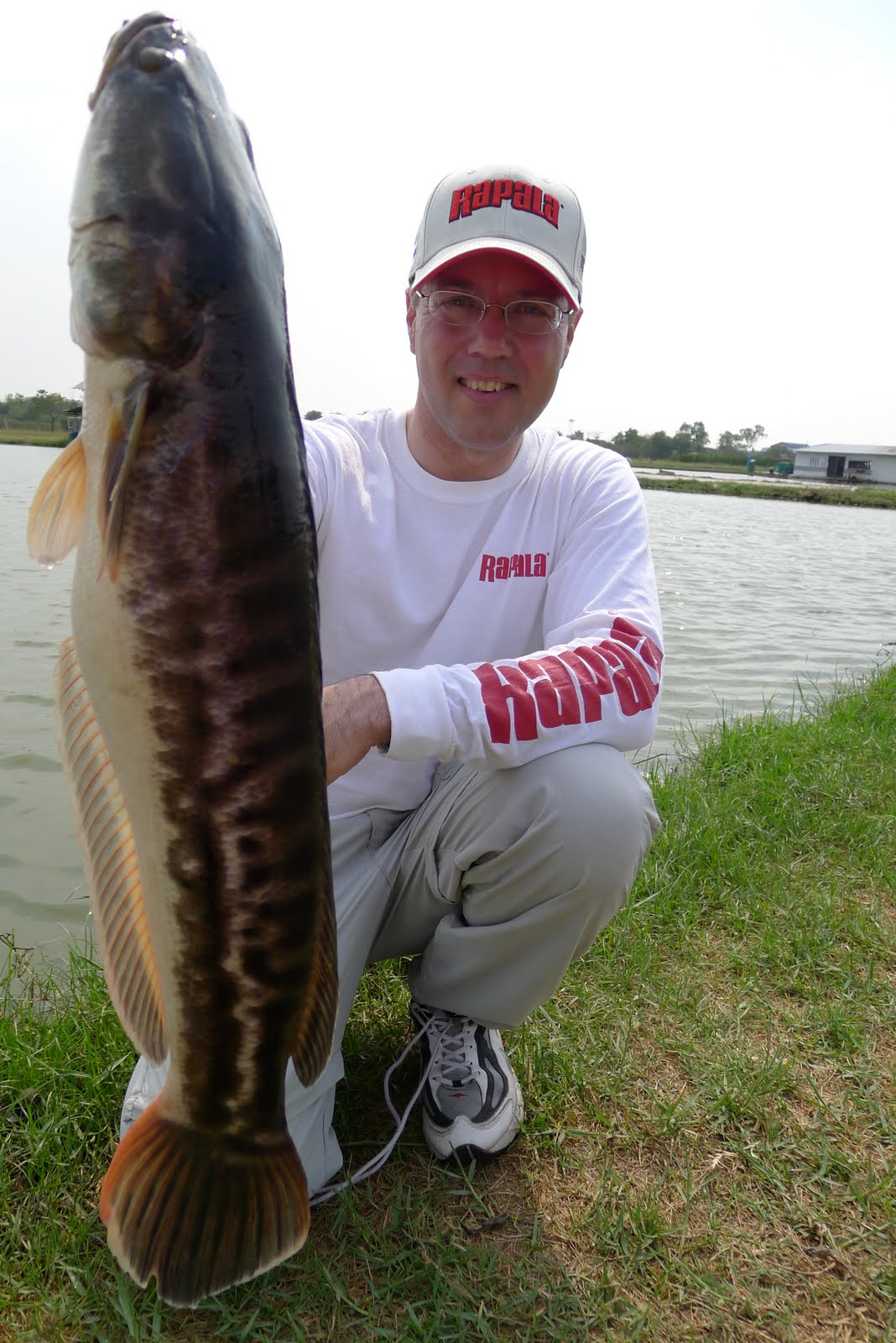
GIANT SNAKEHEADS


Giant Snakeheads can crawl on land and breathe air. They have been known to eat fish, animals, and even attack humans.
Giant Snakeheads are the largest in the Channidae family and capable of reaching lenths of 6 feet and weights up to 66 pounds.
The Giant Snakeheads have a long rounded body with a large snakelike head and a mouth full of fang like teeth. They are black/grey in coloration with silver/purple patterns across its upper body and a white belly.
During breeding the male Giant Snakehead looks after the fry while the mother attacks any preditors even sometimes humans which get too close.
Giant Snakeheads were found in Maryland in 2002 and are abundant in Florida while the largest are found in places such as Thailand.
Giant Snakeheads are fantastic fighters which put on drag buring runs when hooked. They routinely take topwater lures and subsurface spinners and minnow type lures.
If you looking to add the Giant Snakehead to you list of trophies, contact
Francois Helias at www.anglingthailand.com

Monday, May 23, 2011

ALLIGATOR GAR


Alligator gar are the largest of the 7 known gar species. These gar get enormous reaching lengths of possibly 10 feet and weighing over 300 pounds.


Alligator gar have been in existance for years swimming with the dinosaurs. However, today they live in only North and Central America and have been introduced into a few ponds in Thailand.


These behemouths are generally green in coloration and have a heavily scaled body. They have an alligator-like snout with hundreds of needle-sharp teeth.


Recently many large alligator gar have been landed from the Trinity River, Texas.


In earlier years, alligator gar were considered "dangerous" and were reported to attack humans. Many thought this predator destroyed game fish stocks so there were large scaled commerical fishing to get rid of these beasts.


However due to its recent exposure on television, alligator gar are now protected by law.


The current IGFA record was landed by Bill Valverde while fishing the Rio Grande in Texas during 1951. The monster weighed 279lbs. However, reports are the Kenny Williams landed monster alligator gar weighing 327lbs that had a length of 8 1/2 feet and girth of 47.95 inches on Feburary 2011 while fishing Lake Chotard in Mississippi

Sunday, May 22, 2011

PACU


Pacu are close relatives to the piranha. However they have squarer straighter teeth with a less severe underbite. They are primarily found in South America and have been introduced into ponds in Thailand.
In South America there are a few different species which fit into this catagory such as the Tambaqui and Pirapitinga.
The Tambaqui can get huge with specimens of 3 feet in length and over 70lbs being reported. They are extremely strong fish and put up a fantastic fight when hooked.
The Tambaqui has a golden to olvie green back and an purple to black ventral area. Their set of teeth reminds one of a set of human dentures.
The Pirapitinga is very similar to the Tanbaqui however it is slightly smaller and has a second row of molars in the upper jaw whereas the Tambaqui has a single row.
Both species are some of the best fighting fish in freshwater. Both are known primarily as fruit, nut, and flower eaters unlike the piranha!
Both species are very good tablefare and are highly sought after by local fishermen.
To catch some monster Pacu contact Francois Helias at www.anglingthailand.com to fish in Thailand and/or Rodrigo Salles at www.untamedangling.com where you can catch monster Pirapitinga in Bolivia

Saturday, May 21, 2011

TIGERFISH


Ever since I seriously got involved in fishing for exotic species in foreign lands, Africa was always on the top of my dream list targeting tigerfish! I dreamed of fishing along side giant man-eating crocs, boat flipping hippos, dangerous elephants, lions, cape buffalo, plus other man eaters!!!


In 2010 my dream came true when I had the opportunity to fish the Mnyera and Ruhuji Rivers in Tanzania. The Tigerfish found here grown to impressive sizes and are considered to be a cross between the Tigerfish and Goliath Tigerfish. Our group landed a few over 20lbs. Many of our Tigers bite through the landing nets with their massive teeth and our guides had numerous bite marks on their arms and legs.


Tigerfish are known for their set of massive teeth. They are among the best known and most important game fishes in Africa. The tigerfishes belong to the Chjaracidae family which contains species such as piranhas and payaras.


The tigerfish has a deep folked caudal fin which is red in coloration with a black edge. Black horizontal stirps run through each scale row. They grow to about 34lbs but average around 4 to 6lbs.


Goliath Tigerfish are found mostly in the dangerous Congo River. They are silver in coloration with no strips as found on the tigerfish. It has 14 or more teeth in the upper jaw.


Both the Tigerfish and Goliath Tigerfish readily take lures. Both species jump repeatedly when hooked. Due to the sharp teeth and hard boney mouths they are difficult to drive a hook into. A wire leader is essential for both species due to the sharp teeth.


The current World Record Goliath Tigerfish according to the IGFA was landed by Raymond Houtmans on July 9, 1988 which weighed a massive 97lbs. Dr. Henry Gillet writes in his "Game Fish of the World" that he landed a Goliath weighing 87 1/2lbs but lost one that weighed at least twice that weight.


The current World Record Tigerfish according to the IGFA was landed by Jennifer Daynes on September 12 2001 weighing in at 35lbs 7oz.


Hopefully some day the Congo will become politically safe and I can hook up to a Goliath and again return to Tanzania to battle again with these teethy critters!!

Friday, May 20, 2011

SILVER SALMON (COHO)


Silver Salmon are found in the Pacific Ocean and the rivers following into it from Northern Japan to the Anadry River, Russia, and from Northern Alaska south to Monterey Bay, California. They were transported into the Great Lakes and into freshwater lakes in Alaska and the U.S. Pacific coast as well as into Argentina and Chile.


Silver Salmon are also known as Coho Salmon. As with most Pacific Salmon they spending the majority of their lives in the Ocean for 4 to 6 yrs where they reach maturity.


An estimated 85 percent of native Pacific silvers return to spawn in the same stream where they began their life. Once entering the freshwater, these salmon will never return back to the ocean and die after spawning is complete.


During the spawning ritual, the male silver tend to turn somewhat darker on the back. During the spawning run a red coloration is exhibited on it's body. The males develop a kype with both the lower and upper jaw being extended where it becomes almost impossible to close it's mouth. Like all Pacific salmon they do not feed once it enters freshwater on the spawning run. They however will constantly hit lures out of instinct.


According to the IGFA, the World Record Silver Salmon is 33lbs 4oz landed by Jerry Lifton on Sep 27 1989 while fishing the Salmon River in Pulaski, New York.


Silver Salmon can be caught in abundance in freshwater streams and river using convential lures such as in-line spinners and pixee spoons. They also are caught by various flies.


Some of the best silver salmon fishing I know of occurs each August and September on the Alaska Peninsula. Here 50 to 75 silvers landed in a day's fishing is possible.


I have fished the Cinder River on the Alaska Peninsula out of Gary LaRose's Pumice Creek Lodge and have experienced fantastic silver fishing. For more information on this fabulous lodge check out http://www.garylarose.com/

Wednesday, May 18, 2011

POTENTIAL WORLD RECORD REDEAR SUNFISH


According to Field and Stream Magazine, angler Robert Lawler has caught the potential World Record Sunfish. Lawler was bass fishing on Lake Havasu in Arizona on May 2nd when the monster hit.. Knowing the fish was record size, Lawler had it officially weighed where it came out at 5lbs 8oz. The current World Record is 5lbs 7oz by Amos Gay caught in 1998. According to the IGFA World Record Rules, fish weighing 25lbs or less must top the World Record by a minimum of 2oz, therefore, Lawler will gain a tie if his sunfish meets all IGFA requirements. Lawler was fishing with a 7 inch Berkley Power Worm.

Tuesday, May 17, 2011

PIRARARA


The Pirarara is a monster catfish caught in the Amazon basin and can also be landed in some of the Thailand ponds.


The name Pirarara roughly means "parrot fish" due to it containing "arara" which represents the vivid macaw. In English it is known as a redtail catfish.


Besides it massive tail, it possesses a monsterous head which makes up over 1/3 of its body. The head is covered with a bone like armour to protect it from it's enemies if any!


The body coloration is a dark black old leather colored skin and cream white underside.


Once landed the Pirarara lets out a bellowing sound from the air being expelled from its gills.


They have been known to reach weights of 51.5kg.


Normally they are landed using dead fish as bait. The Pirarara is a great fighter with drag burning runs.


In Thailand under the guidance of Francois Helios numerous Pirarara can be landed each day until your arms wear out. Contact Francois for more info to land this species at


JULLIEN'S PRIZED GOLDEN CARP


The Jullien's Prized Golden Carp is found in the Chao Phraya and Mekong Basins of Indo-China and Thailand, and the Pakang and Perak basis of Malaysia.


These monsters can reach weights of 154lbs and 4.9 feet long.


The body is brown to red in color with dark brown stripes. The fins and tail are orange and it has a rounded snout with small lips.


The Jullien's Prized Golden Carp is threatened by overfishing and human capture of it's spawn that have a high market price. These fish are highly protected in Laos where it is forbidden to catch, trade, or transport the Jullien's Prized Golden Carp.


In places such as Thailand, fishing is allowed under strict catch and release rules.


Jean-Francois Helias of http://www.anglingthailand.com/ knows the best places and best times when this rare species can be landed. Anglers world wide have this species on top of their wish list to catch.


I personally have fished with Francois and have landed a few of these rare carp and find them to one of the best fighting freshwater fish worldwide.


For more information on Jullien's Prized Golden Carp and lots of other species in Thailand, contact Francois at fishasia@ksc.th.com