Saturday, May 21, 2011

TIGERFISH


Ever since I seriously got involved in fishing for exotic species in foreign lands, Africa was always on the top of my dream list targeting tigerfish! I dreamed of fishing along side giant man-eating crocs, boat flipping hippos, dangerous elephants, lions, cape buffalo, plus other man eaters!!!


In 2010 my dream came true when I had the opportunity to fish the Mnyera and Ruhuji Rivers in Tanzania. The Tigerfish found here grown to impressive sizes and are considered to be a cross between the Tigerfish and Goliath Tigerfish. Our group landed a few over 20lbs. Many of our Tigers bite through the landing nets with their massive teeth and our guides had numerous bite marks on their arms and legs.


Tigerfish are known for their set of massive teeth. They are among the best known and most important game fishes in Africa. The tigerfishes belong to the Chjaracidae family which contains species such as piranhas and payaras.


The tigerfish has a deep folked caudal fin which is red in coloration with a black edge. Black horizontal stirps run through each scale row. They grow to about 34lbs but average around 4 to 6lbs.


Goliath Tigerfish are found mostly in the dangerous Congo River. They are silver in coloration with no strips as found on the tigerfish. It has 14 or more teeth in the upper jaw.


Both the Tigerfish and Goliath Tigerfish readily take lures. Both species jump repeatedly when hooked. Due to the sharp teeth and hard boney mouths they are difficult to drive a hook into. A wire leader is essential for both species due to the sharp teeth.


The current World Record Goliath Tigerfish according to the IGFA was landed by Raymond Houtmans on July 9, 1988 which weighed a massive 97lbs. Dr. Henry Gillet writes in his "Game Fish of the World" that he landed a Goliath weighing 87 1/2lbs but lost one that weighed at least twice that weight.


The current World Record Tigerfish according to the IGFA was landed by Jennifer Daynes on September 12 2001 weighing in at 35lbs 7oz.


Hopefully some day the Congo will become politically safe and I can hook up to a Goliath and again return to Tanzania to battle again with these teethy critters!!

Friday, May 20, 2011

SILVER SALMON (COHO)


Silver Salmon are found in the Pacific Ocean and the rivers following into it from Northern Japan to the Anadry River, Russia, and from Northern Alaska south to Monterey Bay, California. They were transported into the Great Lakes and into freshwater lakes in Alaska and the U.S. Pacific coast as well as into Argentina and Chile.


Silver Salmon are also known as Coho Salmon. As with most Pacific Salmon they spending the majority of their lives in the Ocean for 4 to 6 yrs where they reach maturity.


An estimated 85 percent of native Pacific silvers return to spawn in the same stream where they began their life. Once entering the freshwater, these salmon will never return back to the ocean and die after spawning is complete.


During the spawning ritual, the male silver tend to turn somewhat darker on the back. During the spawning run a red coloration is exhibited on it's body. The males develop a kype with both the lower and upper jaw being extended where it becomes almost impossible to close it's mouth. Like all Pacific salmon they do not feed once it enters freshwater on the spawning run. They however will constantly hit lures out of instinct.


According to the IGFA, the World Record Silver Salmon is 33lbs 4oz landed by Jerry Lifton on Sep 27 1989 while fishing the Salmon River in Pulaski, New York.


Silver Salmon can be caught in abundance in freshwater streams and river using convential lures such as in-line spinners and pixee spoons. They also are caught by various flies.


Some of the best silver salmon fishing I know of occurs each August and September on the Alaska Peninsula. Here 50 to 75 silvers landed in a day's fishing is possible.


I have fished the Cinder River on the Alaska Peninsula out of Gary LaRose's Pumice Creek Lodge and have experienced fantastic silver fishing. For more information on this fabulous lodge check out http://www.garylarose.com/

Wednesday, May 18, 2011

POTENTIAL WORLD RECORD REDEAR SUNFISH


According to Field and Stream Magazine, angler Robert Lawler has caught the potential World Record Sunfish. Lawler was bass fishing on Lake Havasu in Arizona on May 2nd when the monster hit.. Knowing the fish was record size, Lawler had it officially weighed where it came out at 5lbs 8oz. The current World Record is 5lbs 7oz by Amos Gay caught in 1998. According to the IGFA World Record Rules, fish weighing 25lbs or less must top the World Record by a minimum of 2oz, therefore, Lawler will gain a tie if his sunfish meets all IGFA requirements. Lawler was fishing with a 7 inch Berkley Power Worm.

Tuesday, May 17, 2011

PIRARARA


The Pirarara is a monster catfish caught in the Amazon basin and can also be landed in some of the Thailand ponds.


The name Pirarara roughly means "parrot fish" due to it containing "arara" which represents the vivid macaw. In English it is known as a redtail catfish.


Besides it massive tail, it possesses a monsterous head which makes up over 1/3 of its body. The head is covered with a bone like armour to protect it from it's enemies if any!


The body coloration is a dark black old leather colored skin and cream white underside.


Once landed the Pirarara lets out a bellowing sound from the air being expelled from its gills.


They have been known to reach weights of 51.5kg.


Normally they are landed using dead fish as bait. The Pirarara is a great fighter with drag burning runs.


In Thailand under the guidance of Francois Helios numerous Pirarara can be landed each day until your arms wear out. Contact Francois for more info to land this species at


JULLIEN'S PRIZED GOLDEN CARP


The Jullien's Prized Golden Carp is found in the Chao Phraya and Mekong Basins of Indo-China and Thailand, and the Pakang and Perak basis of Malaysia.


These monsters can reach weights of 154lbs and 4.9 feet long.


The body is brown to red in color with dark brown stripes. The fins and tail are orange and it has a rounded snout with small lips.


The Jullien's Prized Golden Carp is threatened by overfishing and human capture of it's spawn that have a high market price. These fish are highly protected in Laos where it is forbidden to catch, trade, or transport the Jullien's Prized Golden Carp.


In places such as Thailand, fishing is allowed under strict catch and release rules.


Jean-Francois Helias of http://www.anglingthailand.com/ knows the best places and best times when this rare species can be landed. Anglers world wide have this species on top of their wish list to catch.


I personally have fished with Francois and have landed a few of these rare carp and find them to one of the best fighting freshwater fish worldwide.


For more information on Jullien's Prized Golden Carp and lots of other species in Thailand, contact Francois at fishasia@ksc.th.com


Sunday, May 15, 2011

La Zona 2012 Season


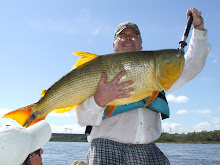
A few prime dates remain open for La Zona in January, March, and April of 2012. These dates should provide excellent fishing for trophy golden dorado. Normally the topwater action is good during these time periods with low water.


La Zona is located on the Uruguay River on the border of Argentina/Uruguay. During your trip you will stay 5 nights at La Zona Lodge and fish for 4 days (Friday to Monday) . The meals at La Zona Lodge are probably the best world wide for fishing lodges.


La Zona Lodge boasts of having the best head guides, Enzo and Elvio, on the Uruguay River. These guys know where the monster dorado swim and the best techniques to land them.


These prime dates will for sure fill quickly. Book now to get into the biggest dorado in the world!For more information contact Steve Yatomi at http://www.adventuretravelalliance.com/ plus you can follow http://www.untamedangling.blogspot.com/ for weekly golden dorado reports.

Friday, May 13, 2011

Making Wire Leaders


Wire leaders are necessary when battling fish with razor sharp teeth which can cut through the best of lines. Making your own wire leaders is simple and can save you lots of bucks $$$.


When fishing for species such as dorado, I use 135lbs coated wire from the American Fishing Wire Company. I crimp on a size #6 Berkley Cross-Lok Snap on one end of the wire and crimp on a size #4 SPRO Power Swivel on the other end. I normally make the leaders about 9 to 12 inches long.


For tigerfish and other species which don't grow as large, I might use 70 to 90lbs wire the the same above components.


Recently some companies have come out with knotable leader material such as TYGER. This wire is very flexible whereas you can tie all your basic knots and eliminate the crimps which are often the weakest portion of the leader.


So, try making your own leaders before your next fishing adventure and save some $$$$